

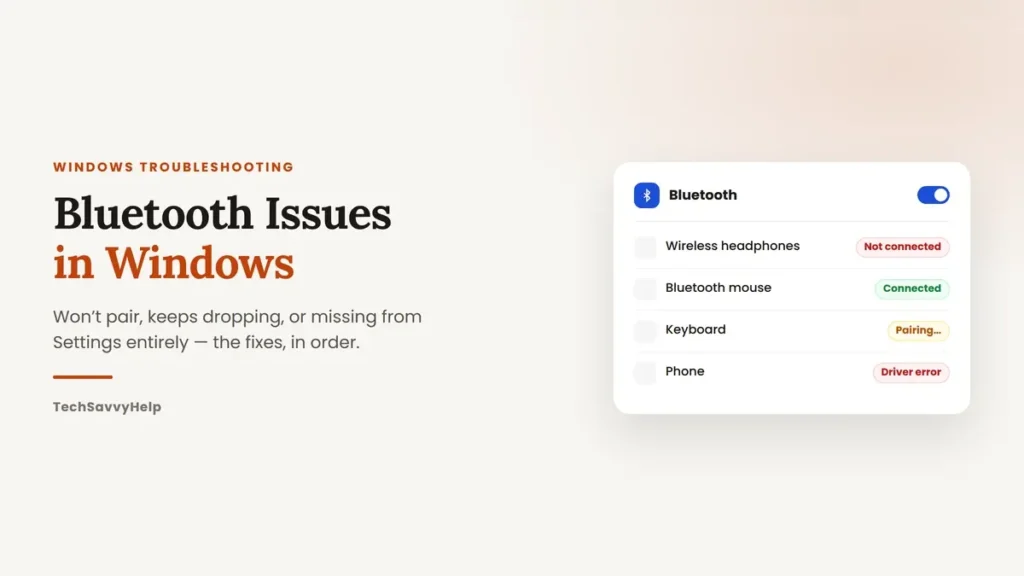
Bluetooth fails in a handful of distinct ways, and they need completely different fixes. A headset that pairs but stutters has nothing in common with an adapter that has vanished from Device Manager — yet most guides hand you the same twenty steps for both.
This one starts by working out which part of the chain has broken, so you can go straight to the fix that applies.
Check the obvious three first: Bluetooth switched on, airplane mode off, and the accessory charged and in pairing mode. If the device still will not appear, set Bluetooth devices discovery to Advanced, then remove and re-pair it. If Bluetooth is missing from Settings entirely, the problem is the adapter or its driver, not the pairing.
Table of Contents
ToggleWhy Bluetooth breaks: the five links in the chain
A Bluetooth connection passes through five things, and a fault in any one of them looks different from the outside. Matching your symptom to the right link saves you working through fixes that were never going to help.

The useful question is not “how do I fix Bluetooth” but “how far down the chain does it get before it fails?” A device that never appears in a scan has not reached Windows at all. One that pairs and then drops has reached Windows and is struggling with the radio.
Try the fixes in this order
If you are not sure which link is at fault, work down this list. It runs from the quickest and safest to the most disruptive, and you stop as soon as the device connects.

Start with the two-minute checks
Confirm Bluetooth is actually on
On Windows 11, select the Network, Sound or Battery icons in the taskbar to open quick settings, and check the Bluetooth tile is active. Or open Start → Settings → Bluetooth & devices and confirm the toggle is on.
If the toggle is missing rather than off, skip ahead to the section on Bluetooth missing from Settings. A missing toggle is a hardware or driver problem, not a settings problem.
On Windows 10 the equivalent is Start → Settings → Devices → Bluetooth & other devices. The steps in this guide are the same on both versions; only the Settings layout differs, and Windows 11 folded the old Devices page into Bluetooth & devices.
Airplane mode, battery and range
Airplane mode switches the radio off entirely and is easy to leave on by accident. Open quick settings and confirm it is off.
Then check the accessory itself: charged, powered on, and close to the PC. Microsoft’s own Bluetooth troubleshooting guidance puts these checks before anything technical, and they resolve a surprising share of cases.
Move the receiver away from USB 3.0 ports
This one is genuinely obscure and genuinely common. Microsoft names USB 3.0 ports as a source of interference with Bluetooth connections. A USB dongle plugged in beside a USB 3.0 device — or into a hub sitting next to one — can produce exactly the stuttering and dropouts you would otherwise blame on drivers.
Move the dongle to a port further away, or use a short extension cable to get it clear of the port cluster, and retest before changing anything else.
When a device will not pair or will not appear
Switch device discovery to Advanced
Windows filters what it shows you while scanning. By default it lists common accessory types only, which is why a device can be broadcasting happily and still never appear.
Go to Start → Settings → Bluetooth & devices → Devices, and under Device settings set Bluetooth devices discovery to Advanced. Then scan again.
Most accessories only stay discoverable for a minute or two after you hold the pairing button. If a scan takes a while, the device has often dropped out of pairing mode before Windows got to it. Put it back into pairing mode immediately before you scan, not before you open Settings.
Remove the device and pair again
A stale pairing record will block a reconnection without ever telling you why. Clearing it is quick and safe.
Open Settings → Bluetooth & devices → Devices, select More options next to the device, then Remove device → Yes. Put the accessory back into pairing mode and add it again.
Restart the Bluetooth Support Service
The Bluetooth Support Service is the Windows component that discovers and connects remote devices. When it is stuck, the toggle looks fine and the adapter looks healthy, but nothing will connect.
Open Command Prompt or Terminal as administrator and run:
net stop bthserv
net start bthserv
You can do the same through services.msc: find Bluetooth Support Service, right-click and choose Restart. While you are there, set its startup type to Automatic if it is not already.
Repair the driver
Microsoft is direct about this: an outdated or incompatible driver is one of the most common causes of Bluetooth connection problems. If the basic checks have not helped, this is where to look next.
Update the driver
Open Device Manager, expand Bluetooth, and find your adapter — its name often includes the word radio. Right-click it and choose Update driver → Search automatically for updated driver software, then restart if prompted.
If Windows reports that the best driver is already installed, that is not the end of it. Check your PC or laptop manufacturer’s support page for your exact model. Vendor drivers are frequently newer than what Windows Update offers, particularly for laptops with combined Wi-Fi and Bluetooth cards.
Uninstall the adapter and let Windows put it back
If updating changes nothing, remove the adapter and let Windows detect it fresh. In Device Manager, right-click the Bluetooth adapter and choose Uninstall device → Uninstall. Shut down, then start the PC again — Windows reinstalls the adapter automatically on boot.
Use shut down and start rather than restart. It is the sequence Microsoft specifies for this step.
What Code 10 and Code 43 actually mean
If the adapter shows a warning triangle, open its properties and read the status message. Two codes come up constantly, and they mean different things.
Code 10 — “This device cannot start”. A driver in the stack failed to start the device. Microsoft’s stated resolution is to update the driver, and the message itself suggests exactly that.
Code 43 — “Windows has stopped this device because it has reported problems”. The driver reported that the device itself failed. Microsoft’s resolution here is different: uninstall and reinstall the device, as above.
So Code 10 points at the driver and Code 43 points at the device. Reaching for a driver update on a Code 43 is a common way to waste an afternoon.
When Bluetooth is missing from Settings and Device Manager
No toggle in Settings and no Bluetooth section in Device Manager usually means Windows cannot see the adapter at all.
In Device Manager, open the View menu and select Show hidden devices, then look again under Bluetooth and under Network adapters. If it appears greyed out, it is present but disabled — right-click and enable it.
If nothing appears at all, right-click your computer name at the top of the Device Manager tree and choose Scan for hardware changes. On a desktop with an add-in wireless card, it is also worth confirming the card is seated properly and, if your firmware exposes the setting, that onboard Bluetooth has not been disabled in BIOS/UEFI.
Run the troubleshooter — and what changed in Windows 11
The Bluetooth troubleshooter still exists, but it is not the tool it used to be. Microsoft has deprecated the Microsoft Support Diagnostic Tool and the legacy troubleshooters built on it. Bluetooth was one of ten troubleshooters redirected into the Get Help app rather than removed.
The route is unchanged: Settings → System → Troubleshoot → Other troubleshooters, then Run next to Bluetooth. What opens is now Get Help rather than the old dialog.
Any guide that tells you to run msdt.exe directly, or shows the old blue troubleshooter window, is describing a tool that is being retired. If the command does nothing on your PC, it is not broken — the platform has gone.
If it stopped working right after a Windows update
Bluetooth breaking immediately after an update is a specific pattern with a specific first move: check whether the update replaced your working driver with a generic one.
In Device Manager, open the adapter’s properties and look at the Driver tab. If Roll Back Driver is available, the driver changed recently and rolling back will tell you quickly whether that was the cause. If the button is greyed out, no previous version is stored and the update is probably not the culprit.
What else the August 2026 update broke, and how to fix each one.
When it connects but does not work properly
Audio plays from the wrong device
Headphones that connect but produce no sound are usually connected fine — Windows is simply still sending audio somewhere else. Open Settings → System → Sound and set the headset as the output device under Choose where to play sound.
If the headset appears twice in that list, you are seeing its two profiles: one for stereo playback and one lower-quality profile that carries the microphone. Picking the stereo entry gives better sound; picking the other gives you the mic but noticeably worse audio. That trade-off is a limitation of the profiles themselves, not a fault to fix.
Stutter, dropouts and range
Bluetooth shares the crowded 2.4 GHz band with Wi-Fi, microwaves and plenty else. Dropouts that get worse with distance, or when you put the PC between yourself and the device, point at the radio rather than at software.
Move closer, clear the line of sight, and revisit the USB 3.0 check above. If your Wi-Fi is also unreliable in the same spot, the band itself is congested and the two problems share a cause.
If the 2.4 GHz band is the real problem, this covers the Wi-Fi half of it.
Common mistakes to avoid
- Treating every fault as a driver problem. If the device never appears in a scan, the driver is not involved yet.
- Using a driver-updater utility. Generic packs are a common source of exactly these faults. Use Windows Update or your PC maker’s own files.
- Ignoring where the dongle is plugged in. USB 3.0 interference is documented, and it produces symptoms that look exactly like a software fault.
Frequently Asked Questions
Why does my Bluetooth device connect but not work?
Connected and in use are different states. For audio, Windows may still be sending sound to another output — set the headset as the output device in Settings → System → Sound. For other accessories, a stale pairing is the usual cause: remove the device and pair it again.
Why is there no Bluetooth toggle in Settings?
Windows cannot see the adapter. Open Device Manager, turn on Show hidden devices from the View menu, and check under both Bluetooth and Network adapters. If it is greyed out it is disabled; if it is absent entirely, use Scan for hardware changes.
Is the Bluetooth troubleshooter gone in Windows 11?
No, but it moved. Microsoft deprecated the Microsoft Support Diagnostic Tool and redirected the Bluetooth troubleshooter into the Get Help app. The Settings route is the same; the window that opens is different.
Can a Windows update break Bluetooth?
It can, usually by replacing a working vendor driver with a generic one. Check the adapter’s Driver tab in Device Manager — if Roll Back Driver is available, the driver changed recently and rolling back will tell you quickly whether that was the cause.
Do these steps work on Windows 10?
Yes. The service restart, driver repair, error codes and troubleshooter all behave the same way; only the Settings layout differs. If you are still on Windows 10, it is worth knowing how long security updates continue.
Getting Bluetooth working again
Identify which link in the chain has broken, work down the fix order, and stop as soon as it connects. Almost everything here is reversible, and the one step that changes anything permanent — uninstalling the adapter — is undone by Windows on the next boot.




One Response